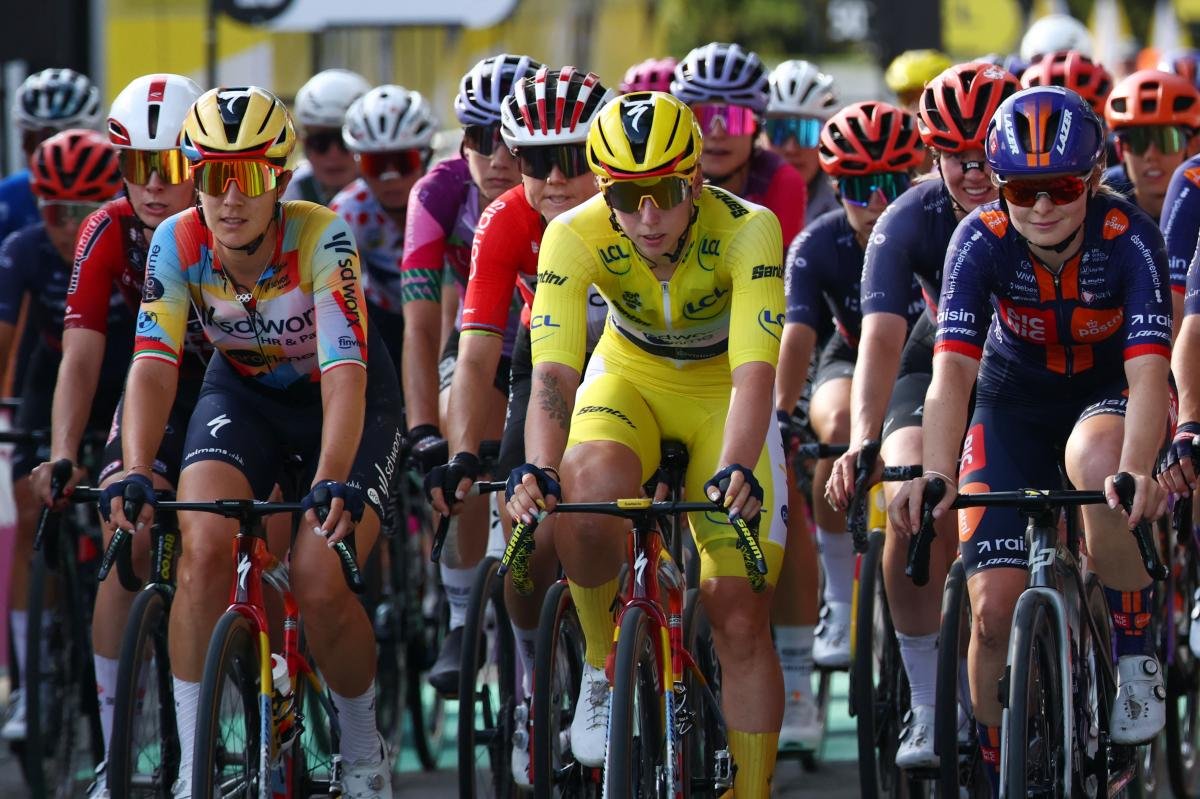
Cycling’s newest performance enhancer isn’t in a syringe — but in a sports bra.
Accusations of padded bras that can give women’s Tour de France competitors an aerodynamic advantage are flying through the cycling world as breast and cup size bizarrely gets debated and even complaints get filed.
Dutch news outlet Wielerflits reported that several complaints have come in from women’s WorldTeams about female cyclists allegedly exploiting their breast size by faking a larger cup size to use more padding in their bras during time trials.
The Tour de France is dealing with a bra controversy. REUTERS
Bert Blocken, professor of aerodynamics at Heriot-Watt University in Scotland and LUT in Finland, concluded in a study that a rounder chest has an advantage as it helps reduce aerodynamic drag through “chest fairing.”
Chest fairing is an object (in this case a pad) that is placed inside a jersey or skinsuit to reduce aerodynamic drag and smooth airflow around the body, which helps gain speed.
“We are talking about a Chest Fairing, which alters the airflow around the body, thereby reducing overpressure on the thighs. As a result, the rider experiences less air resistance,” said Professor Blocken.
Padded bra use is prohibited by the International Cycling Union (UCI), which makes it clear that competitors cannot place objects on the chest or use clothing that alters body shape.
Teams are calling for bra inspections JEAN-CHRISTOPHE BOTT/EPA/Shutterstock
“It is not that you gain a benefit of tens of seconds with this in a time trial, but in a ride of 20 to 30 kilometers, it can yield seconds that can be decisive,” Professor Blocken continued.
In complaints made to the UCI, teams want female padded bra inspectors to come in and check the riders in a closed tent to “ensure they are not hiding anything in their bras or under their aero clothing.”
The Tour de France has long dealt with cheating controversies, with blood doping having previously infiltrating the cycling world.
Lance Armstrong is known as one of the greatest cyclists of all time, but he was given a lifetime ban from the sport in 2012 after he won seven consecutive Tour de France’s from 1999-2005 for using a combination of EPO, testosterone and other substances.
At the time, the USADA called it the most “sophisticated, professionalized and successful doping program that sport has ever seen.”